Marari is Kerala’s best-kept beach secret — a 2km stretch of palm-fringed sand at an authentic fishing village, 11km from Alleppey. Here is what to know before you visit.
Where is Marari Beach?
Marari Beach (also written Mararikulam Beach) lies in the village of Mararikulam, in Alappuzha (Alleppey) district, approximately 11km north of Alleppey town. It sits at the edge of a traditional fishing village on the Arabian Sea coast. The closest railway station is Mararikulam (served by some trains on the Kochi–Alleppey–Kayamkulam route), and Alleppey town is the main transport hub, reachable by road in about 20 minutes by auto-rickshaw or taxi.
What Makes Marari Different
Marari is frequently recommended as Kerala’s most naturally preserved beach precisely because it has not undergone the commercial development that transformed Kovalam and Varkala. The village behind the beach remains a working fishing community — residents head to sea at night and return at dawn, and their traditional wooden canoes (vallam) are drawn up on the sand throughout the day.
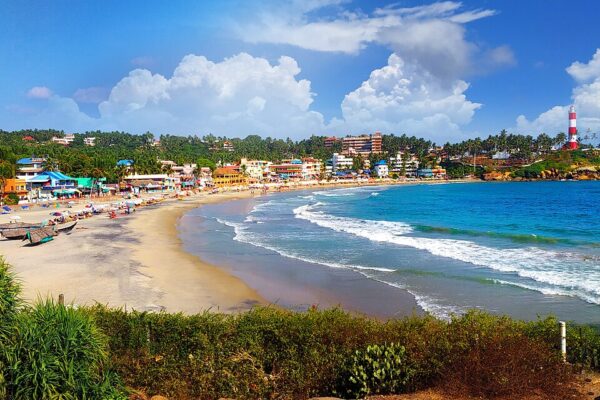
The beach itself is a wide, clean stretch of approximately 2km, lined on the landward side by dense coconut palm groves that separate the sand from the village. The sea here is calmer than Varkala’s clifftop beach and the northern beaches, though the Arabian Sea coast carries seasonal currents and swimming should always be done in calm periods (October to March).
There is no promenade, no hawker-lined seafront road, and no beachside commercial strip. This is part of the appeal for visitors seeking a genuinely quieter coast.
The Fishing Village of Mararikulam
Mararikulam village is predominantly a fishing community that has sustained its traditional way of life alongside the beach resort that now operates on its edge. Walking through the village in the early morning offers one of Kerala’s most authentic coastal experiences: fishermen sorting the night’s catch, women laying fish to dry on woven mats, children going to school, and the rhythmic sound of nets being repaired. Chinese fishing nets (cheena vala) — the large, shore-operated cantilevered nets that are one of Kochi’s most photographed sights — are also present along the shoreline at Mararikulam, though on a smaller scale than at Fort Kochi.
The village has a small church (St. Andrew’s Church, a whitewashed Catholic church serving the fishing community) and the local market. The community is predominantly Syrian Christian — this stretch of the Kerala coast was converted to Christianity by Franciscan missionaries in the 16th century, and the community has maintained its faith over generations.
Best Time to Visit Marari Beach
The optimal season for Marari, as with all of Kerala’s coastal destinations, is October to March. During this period the sea is calm, skies are clear, and temperatures are comfortable (25–32°C). The beach is at its most swimmable.
April and May are very hot (35–38°C) with increasing humidity. The monsoon (June to September) brings heavy rain, rough seas, and strong currents — swimming is not advised during this period, and the beach takes on a different, more dramatic character with grey skies and powerful surf. Some visitors appreciate the monsoon for its quietness and dramatically different atmosphere, and accommodation rates are significantly lower.
Things to Do at and Around Marari
Beach Walking and Swimming
The uncrowded beach is ideal for early morning and evening walks. Swimming is good between October and March; check conditions locally before entering the water. There are no lifeguard services at the public beach areas — only at the Marari Beach Resort’s own section of shore.
Cycling Through Coconut Groves
The countryside around Mararikulam is flat, and the network of lanes through coconut groves, paddy fields, and fishing hamlets is excellent for cycling. Bicycles are available to rent from guesthouses (usually ₹100–150 per day). The 11km road between Marari and Alleppey passes through similarly rural scenery and can be cycled in about 45 minutes.
Backwater Day Trips
Marari’s proximity to Alleppey’s famous backwater network is a major advantage. The Vembanad Lake and the Alappuzha backwater canals are a short distance away — a houseboat or shikara tour from Alleppey is a natural complement to a beach stay at Marari. Many travellers combine 1–2 nights at Marari with a 1-night houseboat cruise.
Yoga and Ayurveda
Several guesthouses and the Marari Beach Resort offer yoga sessions and Ayurvedic massage treatments. Marari’s quiet pace makes it well-suited for a slower, wellness-oriented visit.
Visiting Alleppey
Alleppey town (11km) is worth a half-day visit for its network of canals, the beach, the lighthouse (open to visitors), and the Krishnapuram Palace Museum at Kayamkulam (about 20km further south). Alleppey’s morning fish market at the boat jetty area is lively and photogenic.
Accommodation at Marari
Marari Beach Resort (CGH Earth)
The CGH Earth group’s Marari Beach Resort is the destination property that first drew attention to this stretch of coast. Set on a 26-acre site between the beach and a fishing village, it was designed as an eco-resort following principles of low environmental impact. Accommodation is in thatched cottages arranged in a village-style layout, with organic gardens, an Ayurveda centre, yoga pavilion, and a large swimming pool. The property has repeatedly won awards for sustainable hospitality. Room rates range from approximately ₹15,000–25,000 per night (high season), including breakfast. Contact: cghearth.com
Guesthouses and Homestays
Mararikulam village has a range of smaller guesthouses and family-run homestays that offer excellent value. These typically charge ₹1,500–4,000 per night and provide a much more direct experience of the village setting. Many are within walking distance of the beach. Booking platforms including booking.com list verified properties.
Getting to Marari Beach
- From Kochi (Ernakulam): 90km, approximately 2 hours by car or taxi. The route runs south via NH66.
- From Alleppey town: 11km, 20 minutes by auto-rickshaw (approximately ₹200–250) or taxi.
- By train: Mararikulam is a minor station on the Kochi–Alleppey–Kayamkulam route. Not all trains stop here — check Indian Railways (irctc.co.in) for services. Alleppey Junction is the main station for the region, well-connected to Kochi, Thiruvananthapuram, and other cities.
- By bus: KSRTC buses run on the Alleppey–Kayamkulam coastal road and stop at Mararikulam Junction. Walk approximately 1–2km from the junction to the beach.
Combining Marari with Other Kerala Destinations
Marari works well as part of a wider Kerala itinerary. Common combinations include:
- Marari + Alleppey backwaters: 2 nights at Marari, 1 night on a houseboat in Alleppey’s backwaters.
- Marari + Kumarakom: Continue north-east to Kumarakom (about 50km) for bird sanctuary and Vembanad Lake views.
- Marari + Kochi: Start in Kochi (Fort Kochi heritage, backwaters) and drive south to Marari as a coastal finale.
- South Kerala Circuit: Marari sits midway on a coastal drive between Kochi in the north and Varkala/Thiruvananthapuram in the south.

You might also like
 Beaches
Varkala Cliff Beach Guide: Surfing, Yoga, Temple & Where to Stay
Varkala travel guide: the cliff path, Papanasam Beach, surfing lessons, yoga classes, Jana…
 Beaches
Kovalam Beach Guide: Surfing, Yoga, Ayurveda & What to Know
Complete Kovalam guide: the three beaches, surfing lessons, yoga centres, Ayurveda resorts…
Bekal Fort & Beach, Kerala: The North’s Hidden Coastal Treasure
Bekal Fort is Kerala's largest fort — a 17th-century fortification on a 40-acre sea prom…