Bekal Fort is Kerala’s largest fort — a 17th-century fortification on a 40-acre sea promontory — beside a wide, clean beach in Kerala’s quiet, underexplored north.
Where is Bekal?
Bekal lies in Kasaragod district, the northernmost district of Kerala, approximately 60km south of Mangalore and 160km north of Kozhikode (Calicut). It sits at the junction of two states — Karnataka begins just north of Kasaragod — and the region has long been a cultural meeting point between Kerala, Karnataka, and Tulu-speaking traditions.
Bekal is best known for its fort — the largest fort in Kerala — which stands on a laterite headland jutting into the Arabian Sea, commanding views of the ocean on three sides. The adjacent Bekal Beach is one of the cleanest and least crowded beaches on Kerala’s northern coast. Together, the fort and beach form one of the most distinctive sights in the state.
Bekal Fort: Kerala’s Largest Fort
Bekal Fort occupies approximately 40 acres of a natural basalt and laterite promontory that extends into the sea. The fort’s shape, when viewed from above, resembles a keyhole or mushroom — a wide circular bastion connected to the mainland by a narrower neck. This natural configuration, combined with the fort’s thick laterite walls, made it virtually impregnable from the sea.
History
The main fortification structures date to around 1650 CE, built under Shivappa Nayaka (reigned 1645–1660 CE), the king of the Keladi (also called Ikkeri) Nayaka kingdom, based in Shimoga in present-day Karnataka. The Keladi Nayakas were a powerful dynasty that controlled much of the coastal region between the Malabar and Karnataka coasts during the mid-17th century.
Control of Bekal passed through several powers:
- Keladi Nayakas (c.1650–1763): The fort’s principal builders and controllers for over a century.
- Hyder Ali (1763): Hyder Ali, the Sultan of Mysore and father of Tipu Sultan, captured the Keladi kingdom and took control of Bekal and the surrounding Kasaragod territory.
- Tipu Sultan (1763–1799): Tipu Sultan (Hyder Ali’s son and successor) further fortified Bekal as part of his defensive network against British expansion. The British-Mysore wars culminated in the Battle of Seringapatnam (1799), in which Tipu Sultan was killed.
- British East India Company (1799 onward): Following Tipu Sultan’s defeat, Bekal came under British control as part of the settlement of Malabar. The British maintained the fort but undertook no significant new construction.
Bekal Fort is currently maintained by the Archaeological Survey of India (ASI) as a protected monument. It is one of the best-preserved forts in Kerala.
Inside the Fort
Visitors entering through the main gateway (facing east, away from the sea) encounter a large interior space with several structures:
- Observation Tower: The principal bastion of the fort rises as a large circular tower at the sea-facing tip of the promontory. Climbing to its top gives panoramic views of the Arabian Sea on three sides, with the beach visible to the south and the mangroves of the Kappil backwater to the north. The tower is the defining view associated with Bekal.
- Water Tank: An enormous freshwater storage tank inside the fort, originally providing water for the garrison. It is still filled today and is one of the most picturesque spots inside the walls.
- Underground Passages and Tunnels: A network of underground rooms and corridors, used historically for storage, ammunition, and troop movement. Some tunnels lead toward the sea wall.
- Mosque (Hyder Ali’s mosque): A small mosque inside the fort, associated with the period of Mysorean control.
- Sea Wall: The outer walls of the fort on the sea side are particularly dramatic — thick laterite ramparts with cannon positions overlooking the ocean directly below.
The fort is best visited in the early morning (opening time: 8:00 AM) or late afternoon to avoid the midday heat. Entry fee: approximately ₹25 for Indian nationals, ₹300 for foreign nationals (ASI rates; subject to revision). Photography permitted without additional charge.
Bekal Beach
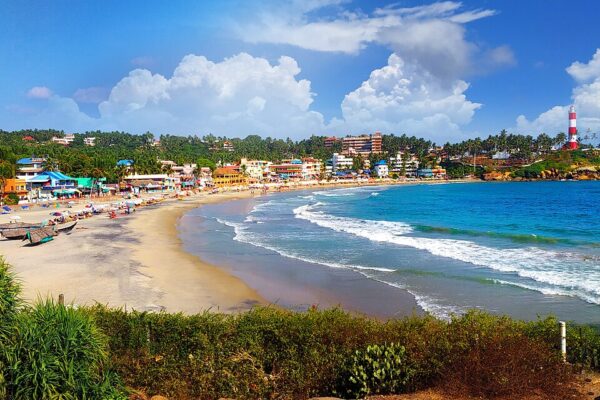
Immediately south of the fort lies Bekal Beach — a wide, 4km stretch of clean sand that runs south from the fort’s outer walls. The beach is managed by the Bekal Resorts Development Corporation (BRDC), a Kerala government undertaking established to develop tourism in the area in an ecologically responsible manner.
Bekal Beach is characterised by its cleanliness (consistently among the best-maintained beaches in north Kerala), its relatively uncrowded character outside peak season, and the dramatic backdrop of the fort’s silhouette to the north. The sea at Bekal is calmer than at some exposed Kerala beaches, making swimming possible for a longer period of the year — though as with all Arabian Sea beaches, the monsoon season (June–September) brings rough surf and currents.
The beachfront has a small park area developed by BRDC with pathways, lighting, and seating. There is no commercial strip of the kind seen at Kovalam or Varkala. Eating and accommodation are found in the town a short distance away, keeping the beachfront itself relatively unencumbered.
Kappil Beach: Where the Backwater Meets the Sea
Approximately 6km north of Bekal is Kappil Beach (also written Kapil or Kappil), a remarkable natural phenomenon: the point where the Kappil Lake (a backwater connected to the Edakal estuary) meets the Arabian Sea, separated by only a narrow strip of sand. The juxtaposition of the calm, still backwater on one side and the open sea on the other — with the sand bar between them, coconut palms fringing the water — is considered one of the most photographed natural scenes in northern Kerala.
Kappil Lake has a boating facility (small motorboats and country boats available from the jetty) allowing exploration of the mangrove-edged backwater and its birdlife. The area is significantly less developed than Alleppey’s backwaters and retains a wilder, more remote character.
Pallikere Beach
Pallikere Beach, 3km north of Bekal town, is an older and quieter beach with a small fishing harbour. It is less visited than Bekal Beach itself but offers a more authentic fishing village atmosphere, with traditional wooden boats drawn up on the sand and local fishing activity in the mornings and evenings.
Nearby Attractions
Chandragiri Fort (Payyanur River)
Approximately 8km south of Bekal, Chandragiri Fort sits at the confluence of the Chandragiri River and the sea. It is a smaller, less elaborate fortification than Bekal, also dating to the Keladi Nayaka period, and now partially in ruins — but the river-mouth setting and surrounding estuary landscape make it worth visiting. Country boat rides on the Chandragiri River are available.
Ananthapura Lake Temple (Kumbla)
Located about 29km east of Kasaragod town (the nearest major town, 12km from Bekal), Ananthapura is the only lake temple in Kerala — a temple dedicated to Ananthapadmanabha (Vishnu reclining on the serpent Ananta) built on an island in the middle of a lake. It is considered the original seat of the deity who was later enshrined at the famous Padmanabhaswamy Temple in Thiruvananthapuram. The temple is architecturally distinctive and the lake setting is peaceful. It is accessible by a short bridge from the shore.
Nileshwar
The town of Nileshwar, 20km south of Kasaragod and 10km south of Bekal, has an old temple complex and a quieter riverside character that provides a contrast to the fort-and-beach tourism zone.
Best Time to Visit Bekal
The best season is October to March: comfortable temperatures (26–32°C), clear skies, and calm seas. November to February is peak tourist season.
April and May are very hot (35–38°C). The monsoon (June to September) brings heavy rainfall — Kasaragod is one of Kerala’s wettest districts, receiving over 3,000mm of annual rainfall — and rough seas. The fort and beach remain impressive in monsoon, with dramatic views, but swimming is not advisable. Accommodation rates are lower in monsoon and the landscape is at its greenest.
Getting to Bekal
- By train: Bekal has its own railway station (Bekal Fort Railway Station, also called Kottikkulam) on the Mangalore–Thiruvananthapuram Coast Railway line. Most express trains on this route stop at Kasaragod (12km north of Bekal), from where local transport is available. The Malabar Express, Netravati Express, and Parasuram Express are among the trains serving this route.
- From Mangalore: 60km, approximately 1.5 hours by car or bus.
- From Kozhikode (Calicut): 160km, approximately 3 hours by NH66.
- From Kochi: 390km, approximately 6 hours by road. For this distance, train is recommended (Kochi to Kasaragod takes approximately 5 hours by express).
- From Kasaragod town: 12km; auto-rickshaws charge approximately ₹150–200; local buses run regularly.
Where to Stay Near Bekal
Bekal’s accommodation options are more limited than the state’s major tourism hubs, but the choices available suit different budgets:
- BRDC Resorts: The Bekal Resorts Development Corporation operates government-category resort properties near the beach, with air-conditioned rooms at mid-range rates. These are the most convenient properties for beach access.
- The Lalit Resort & Spa Bekal: A large luxury resort on a 26-acre heritage estate at the edge of the Kappil backwater and beach, with indoor pool, Ayurveda centre, and multiple restaurants. Rates typically ₹10,000–20,000 per night.
- Neelavara Beach Resort and guesthouses: Several mid-range properties in Kasaragod and Bekal town itself offer rooms at ₹1,500–4,000.
Combining Bekal with Other Destinations
Bekal’s location at the northern tip of Kerala makes it a natural start or finish point for a north-to-south Kerala journey. Common itinerary combinations include:
- Bekal → Wayanad → Coorg (Karnataka): A route combining Kerala’s northern coast with inland hill station scenery. Coorg (Kodagu) in Karnataka is 100km from Kasaragod by road, through the Ghats.
- Bekal → Kozhikode (Calicut): Continuing south to explore the Malabar coast — Kozhikode is a historic spice trading port with excellent seafood, the Kuttichira mosque quarter, and access to Wayanad.
- Bekal → Kannur: 60km south — known for Theyyam (the ritual performance art of north Kerala, performed at temples from October to May), the heritage Fort St Angelo, and Muzhappilangad Drive-in Beach (the only drive-in beach in India).

You might also like
 Beaches
Varkala Cliff Beach Guide: Surfing, Yoga, Temple & Where to Stay
Varkala travel guide: the cliff path, Papanasam Beach, surfing lessons, yoga classes, Jana…
Marari Beach, Kerala: The Quiet Coastal Village Near Alleppey
Marari is Kerala's best-kept beach secret — a 2km stretch of palm-fringed sand at an aut…
 Beaches
Kovalam Beach Guide: Surfing, Yoga, Ayurveda & What to Know
Complete Kovalam guide: the three beaches, surfing lessons, yoga centres, Ayurveda resorts…