Kathakali is one of India’s most visually extraordinary performing arts — elaborate costumes, intense face paintings, and stories from ancient epics told through hand gestures and eye movements.
What is Kathakali?
Kathakali is a highly stylised classical dance-drama that originated in Kerala in the 17th century. The name comes from the Malayalam words Katha (story) and Kali (performance or play). It is one of the eight classical dance forms of India recognised by the Sangeet Natak Akademi, the country’s national academy for music, dance, and drama.
Kathakali is unique among India’s classical performing arts for the extreme elaborateness of its makeup (Chutti), its towering costume elements, the precision of its hand gesture vocabulary (Mudras), and the fact that it draws its narratives almost exclusively from Hindu epics — the Ramayana, the Mahabharata, and the Bhagavata Purana. A single Kathakali performance can last an entire night from dusk to dawn, though shorter programmes of 2–3 hours are now common for wider audiences.
Origins and History
The roots of Kathakali lie in earlier Kerala performance traditions, particularly Krishnanattam (a temple art form depicting the life of Krishna, patronised by the Zamorin of Kozhikode in the 17th century) and Ramanattam (a parallel form depicting the Ramayana, developed by the Kottarakkara Thampuran around 1655 CE). The Kottarakkara Thampuran’s eight-part composition covering the Ramayana — collectively called Ramanattam — is traditionally considered the founding text of Kathakali.
Through the 17th and 18th centuries, the form was refined under the patronage of regional rulers and temple administrations, particularly in the princely states of Travancore, Cochin, and the zamorin’s Kozhikode. By the 20th century, Kathakali had attracted major institutional support: Kerala Kalamandalam, the government deemed university for traditional arts, was founded in 1930 at Cheruthuruthy near Thrissur by the poet Vallathol Narayana Menon, institutionalising the training of Kathakali performers under a formal curriculum.
The Makeup: Chutti
Kathakali makeup (Chutti, from the Malayalam word for a stucco-like rice paste) is among the most complex theatrical makeup systems in the world. It is applied by specialist makeup artists and takes between 2–6 hours depending on the character type. The makeup communicates character type, moral nature, and emotional state before a word (or gesture) is performed.
There are several primary makeup types:
- Pacha (green face): Worn by noble, heroic, and divine characters — kings, heroes such as Arjuna and Rama, and the gods Vishnu and Krishna. The face is painted vivid green using a paste made from rice and lime, with distinctive curling black and red lines. The lips are painted bright red.
- Kathi (knife, red crescent on green face): Worn by characters who are powerful but arrogant or villainous — such as Ravana and Duryodhana. The base is green like Pacha, but a distinctive red crescent is added to each cheek, suggesting a marked (kathi = knife) nature.
- Thadi (beard): Three sub-types: White Thadi (pure characters like Hanuman), Red Thadi (fierce demons), and Black Thadi (hunters and forest dwellers). Elaborate beard structures are made from paper or coconut fibre and attached to the face with rice-starch paste.
- Minukku (radiant): Worn by women, sages, and saints — a natural-looking yellowish makeup with minimal decoration, suggesting inner purity and softness.
- Kari (black face): Worn by demons and female villains — the entire face is painted black, often with exaggerated red-and-white markings.
The Chutti (white stucco border) refers specifically to the elaborate raised white rim built up around the face using rice paste applied layer by layer. This can extend 5–7 centimetres from the face and frames it like a halo. It is applied only to the principal makeup types (Pacha, Kathi, Thadi) and is what creates Kathakali’s immediately recognisable silhouette.
The Costume
Kathakali costumes are equally elaborate. Performers wear multiple layers of fabric in vivid colours — traditionally hand-woven and dyed in natural colours. The costume elements include:
- Kuchippu (skirt): A vast, multilayered fabric skirt that makes the performer’s lower body appear very wide, anchoring the figure visually on stage.
- Mudi (crown): A towering headpiece made of gilded wood, lacquer, and mirrors, extending up to 60 centimetres above the head. Different characters have distinct crown designs.
- Mala (chest ornament): Multiple layered necklaces and chest pieces in gilded papier-mâché and mirrors.
- Kuzhalippoo: Elaborate ear ornaments that extend to the cheek.
The Vocabulary: Mudras and Navarasas
Kathakali’s performance language is entirely non-verbal. Dialogue, description, and narrative are communicated through two interlocking systems:
Mudras (hand gestures): Kathakali uses the Hastalakshana Deepika, a text codifying 24 basic hand gestures that can be combined to create hundreds of words and phrases. The same mudra in the right hand and left hand, or in different positions relative to the body, can produce different meanings. Performers spend years learning to execute mudras with precision, speed, and expressiveness.
Navarasas (nine emotions): Kathakali communicates the nine classical emotions of Sanskrit aesthetics — Shringara (love), Hasya (humour), Karuna (compassion), Raudra (fury), Vira (heroism), Bhayanaka (terror), Bibhatsa (disgust), Adbhuta (wonder), and Shanta (peace) — primarily through facial expression, particularly the eyes. The eyes of a trained Kathakali performer can move independently in extreme ways; much of training involves exercises to gain extraordinary muscular control of the eye socket.
The Music and Percussion
Kathakali is accompanied by two vocalists and three percussion instruments. The vocalists (Ponnani and Shinkidi) sing the narrative text — written in a distinctive dialect called Manipravalam, a blend of Sanskrit and Old Malayalam — while the performers enact it. The main percussion is the Chenda (a cylindrical drum beaten with sticks) and the Maddalam (a barrel-shaped drum). The Chengila (a hand-held gong) marks rhythmic cycles. No string or wind instruments are used in classical Kathakali.
Stories: What Kathakali Performs
The standard Kathakali repertoire consists of about 101 stories (Attaprakara), drawn from the Mahabharata, Ramayana, and Bhagavata Purana. The most performed stories include:
- Nalacharitam: The story of King Nala and Damayanti from the Mahabharata — famous for its lyrical quality.
- Kalyanasaugandhikam: From the Mahabharata — Bhima’s search for the Sougandhika flower for Draupadi, and his encounter with an aged Hanuman.
- Duryodhana Vadham: The climactic duel between Bhima and Duryodhana; known for its intense masculine energy.
- Karna Shapath: Karna’s oath — from the Mahabharata.
- Balivijayam: Vali’s story from the Ramayana.
- Keechakavadham: Bhima’s killing of Keechaka — well known for its graphic intensity.
Where to Watch Kathakali in Kerala
Kerala Kalamandalam (Cheruthuruthy, Thrissur district)
The government deemed university for traditional performing arts, located in Cheruthuruthy village near Shoranur (about 32km north of Thrissur). Founded in 1930, it is the foremost institution for Kathakali training and performance. The Kalamandalam holds regular public performances and runs a heritage museum. Full-night performances are staged on important occasions. Getting there: Train to Shoranur Junction, then auto-rickshaw or bus to Cheruthuruthy (about 5km).
Cultural Centres in Kochi
Fort Kochi is the most accessible place for visitors to watch Kathakali. Several cultural centres hold daily evening shows (typically 5:00–7:00 PM) specifically for tourists, including a 45-minute makeup demonstration before the performance:
- Kerala Kathakali Centre (KB Jacob Road, Fort Kochi) — one of the longest-operating venues.
- Greenix Village (Calvathy Road, Fort Kochi) — evening cultural programme including Kathakali.
- See India Foundation (Bhagavathi Lane, Ernakulam) — focus on Kerala classical arts.
Entry for tourist shows typically costs ₹200–400 per person. The shows are well-suited to first-time audiences — hosts explain the makeup, costume, and gesture vocabulary before the performance.
Thiruvananthapuram
Margi Thiruvananthapuram (near East Fort) is a respected cultural organisation with its own trained troupe offering regular performances. The Nishagandhi Cultural Centre at Kanakakkunnu Palace hosts Kathakali during the annual Nishagandhi Dance Festival (usually January–February).
Attending a Traditional All-Night Performance
Traditional Kathakali begins at dusk (around 7:00–8:00 PM) and runs until sunrise (5:00–6:00 AM). The structure begins with the Thodayam (invocatory piece) and builds through the night. The most dramatic scenes — the great battle sequences, the killings of demons — are saved for the small hours, when the audience is considered most alert through sustained engagement.
Major temple festivals (particularly at temples in Thrissur, Palakkad, and Thiruvananthapuram districts) regularly stage all-night Kathakali as part of their annual festivals. These performances are free to attend, open-air, and represent Kathakali in its purest traditional context. Enquire at temple offices for upcoming performance dates.
Training a Kathakali Performer
A complete Kathakali training requires a minimum of 8–10 years of intensive study. Students at Kerala Kalamandalam begin training as young as 10–12 years old, undergoing a rigorous physical conditioning programme before learning the gesture vocabulary and performance techniques. The training includes daily body massage with medicinal oils, vigorous physical exercises to develop extreme flexibility, and years of repeated practice of each gesture until it is completely internalised. The eyes, which carry so much of the expressive work, are trained through specific exercises using lamp flames and the natural light of dawn.

You might also like
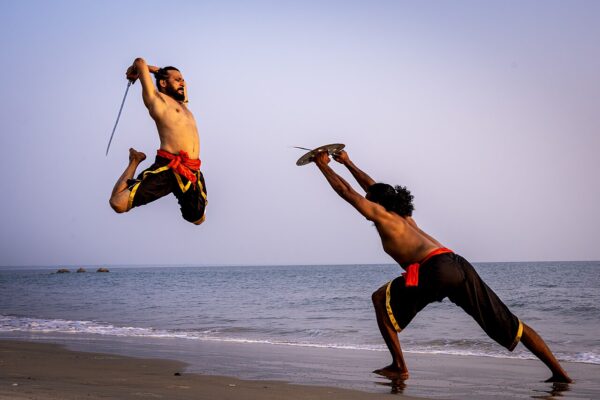 Culture & Arts
Kalaripayattu: Kerala’s Ancient Martial Art — History, Styles & Where to Watch
A complete guide to Kalaripayattu — Kerala's 3,000-year-old martial art. Learn the two s…
 Culture & Arts
Kathakali: Kerala’s Ancient Dance-Drama Explained for Visitors
A visitor's guide to Kathakali — Kerala's classical dance-drama. Learn what the makeup c…
Kannur Travel Guide — Theyyam, St. Angelo Fort & Handloom Heritage
🎭 Kannur District — Land of Theyyam & Handlooms Ancient Portuguese fort, sacred T…