Beyond the houseboats: a guide to Kerala’s backwater village life — coir spinning, toddy tapping, paddy fields in Kuttanad, village canoe tours, and the best homestays on the waterways.
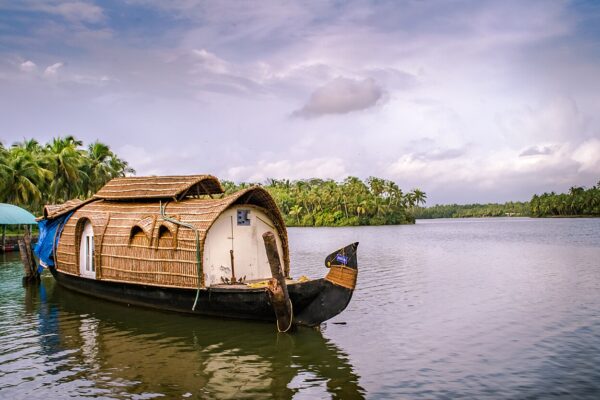
The Kerala backwaters are famous for their houseboats and lake cruises, but the most authentic experience of backwater life has nothing to do with floating hotels. It’s the village canals — the narrow waterways that thread between rice paddies and coconut groves, past coir factories and toddy shops, through clusters of homes where children wave from doorways and fishermen stand knee-deep in the water pulling in nets — that reveal how millions of Keralites have lived for centuries in intimate daily relationship with water.
How Backwater Villages Work
The network of canals and lakes that makes up Kerala’s backwaters — over 900 km of interconnected waterways — is not ornamental. Until the mid-20th century, it was the primary transport and trade system for the entire coastal region. Rice, coir (coconut fibre), spices, fish, and people all moved by boat. Many villages had no roads at all; boats were not a choice but a necessity.
This water-centric life shaped everything: house design (entrances facing the water, small boat jetties attached to every home), food culture (fish from the backwaters at every meal), social patterns (the waterway as marketplace, meeting point, and public square). Even today, despite the roads that now parallel most major canals, backwater villages retain a quality of life that is inseparable from the water around them.
Kuttanad: Kerala’s Rice Bowl
The most extensive backwater agricultural region is Kuttanad — a vast, low-lying area in Alappuzha and Kottayam districts where rice is grown on poders (fields reclaimed from the lake by building earthen embankments). Kuttanad sits below sea level — one of the few places in India where this is true — making it simultaneously extraordinary fertile and permanently vulnerable to flooding.
Paddy cultivation here involves a centuries-old system of pump stations and sluice gates that manage the water level across thousands of acres. During harvest season (February–March and August–September), the fields turn gold and the harvest is conducted partly by boat. Boat journeys through Kuttanad’s paddy-field canals during harvest are among the most beautiful experiences in Kerala.
Coir Villages
Coir — fibre extracted from coconut husks — has been a major industry in the backwater region for centuries, and Kerala produces 60% of the world’s coir. The process is entirely traditional in village settings: husks are retted (soaked) in the backwater canals for 6–12 months to loosen the fibres, then beaten and spun by hand on simple wooden spindles. Women do most of the spinning; men handle the retting and heavy work.
Villages along the canals near Cherthala and Ambalapuzha (Alappuzha district) are still active coir-producing communities. Watching a woman spin coir on a traditional charkha at the edge of the canal, with the water lapping at her feet, is an image that stays with you.
Toddy Tapping
The palm trees that line every canal are not just scenery — they’re working trees. Toddy tappers (chovans) climb bare-handed 20–25 metres up coconut and palmyra palms twice daily, cutting the flower bud to collect the sap (kalli) in a clay pot. Fresh toddy is sweet and mildly fizzy; left to ferment for a day, it becomes potent. Toddy shops (kallu shaappu) are a Kerala institution — informal, all-male, extremely cheap, and serving the best fish curry you’ll eat in the state alongside their clay pots of toddy.
Chinese Fishing Net Villages
Beyond the famous nets at Fort Kochi, Chinese fishing nets (cheena vala) are used across the backwater region, particularly around Vembanad Lake and Punnamada Lake near Alappuzha. In village settings, these are working tools, not tourist attractions — families depend on them. Visiting at dawn, when the net teams are most active, gives a completely different perspective from the tourist area at Fort Kochi.
Best Ways to Experience Backwater Village Life
Village Canal Canoe Tours
A small canoe (shikara) or country boat with a local guide is the ideal way into the narrow village canals that houseboats cannot reach. Half-day tours from Alappuzha, Kumarakom, or Kottayam: ₹600–1,500 per boat. The best operators are those who grew up in the villages they show you — ask your accommodation to connect you with local guides rather than tourist-company boats.
Village Homestays
Staying overnight with a family in a backwater village — rather than on a houseboat — is the most immersive option. The Kerala Tourism homestay programme (Green Leaf and Olive Leaf classifications) covers numerous backwater village properties. You eat what the family eats, travel by the same boats they use, and participate in the rhythms of village life. Rates: ₹1,500–4,000/night including meals.
Kumarakom Bird Sanctuary
On the eastern shore of Vembanad Lake, the Kumarakom Bird Sanctuary is one of Kerala’s most important bird habitats — particularly for migratory species (September–March). The sanctuary is best explored by small boat at dawn, moving silently through the reed beds where herons, cormorants, egrets, darters, and migrant waders concentrate. Siberian storks and painted storks are seen in season. Entry ₹80; boat hire ₹300–500/hour from the jetty.
DTPC Canal Cruise, Alappuzha
The Alappuzha District Tourism Promotion Council runs daily 2.5-hour cruises (₹300/person) through the canal network around Alappuzha town, passing villages, paddy fields, and coir factories. Basic but excellent value and genuinely informative with an onboard guide.
Backwater Villages by District
Alappuzha: The heartland — Kuttanad paddy fields, Punnamada Lake, Kainakary village (authentic, less visited), and the Nehru Trophy Race venue. Kottayam: The canals around Kumarakom and Vaikom are quieter and less touristed than Alappuzha. Ernakulam: Vypin Island and the canal network around Varapuzha offer backwater village life within 30 minutes of Kochi city.
What to Bring and Know
- Start early — the canals are most beautiful at dawn and the wildlife (birds, otters) is most active in the first two hours of daylight
- Sunscreen is essential; you’re on open water with no shade
- A small daypack with water and snacks — village canal tours can run 3–5 hours and shops are rare
- Mosquito repellent for the evenings, especially near the reed beds
- Cash only in village settings — no card machines
📍 Explore the destination: Alappuzha District — Venice of the East
📚 Related: Backwaters & Canal Life

You might also like
Kollam Travel Guide — Cashew Capital, Jatayu Rock & Ashtamudi Backwaters
🌿 Kollam District — Kerala’s Cashew Capital Ancient trade port, tranquil backwa…
 Backwaters
Kerala Houseboats vs Resorts: Which to Choose for Your Backwater Stay
Houseboat or resort for Kerala backwaters? Compare canal immersion, comfort, value and fac…
Kottayam Travel Guide — Land of Letters, Latex and Lakes
📚 Kottayam District — Land of Letters, Latex & Lakes India’s first 100% lit…