Kottappuram Fort, also known as Cranganore Fort, stands at the mouth of the Periyar River at Kodungallur (ancient Cranganore or Muchiri Pattanam) — a site of almost incomparable historical importance in the story of Indian Ocean trade and the arrival of Christianity, Islam, and Judaism in India. Kodungallur is documented in ancient Greek, Roman, Arab, and Chinese texts as one of the great spice ports of antiquity, and the Kottappuram Fort was built by the Portuguese in the early 16th century to command the river entrance to this ancient commercial harbour.
The fort’s visible remains today are substantial though partially ruined — Portuguese-era laterite walls, a gateway, and the remnants of bastions that once covered the river approach. Archaeological excavations in the vicinity of Kodungallur have revealed Roman amphorae, Chinese porcelain, and Rouletted Ware pottery dating from the 1st century BCE to the 3rd century CE — physical evidence of the international trade connections that made ancient Muchiri one of the wealthiest ports on the subcontinent.
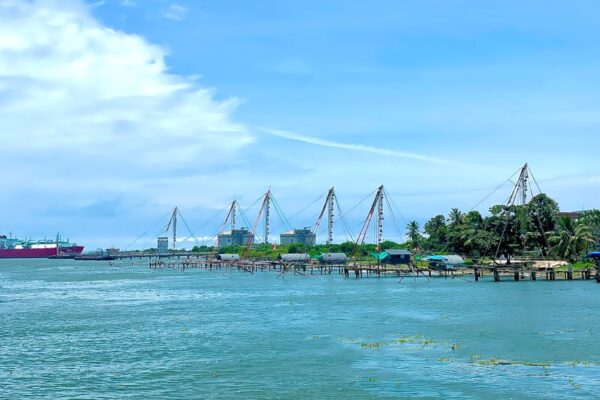
The fort is maintained by the Archaeological Survey of India and can be entered freely. Its setting at the river mouth, with fishing boats crossing the wide estuary and coconut palms lining the far bank, is peaceful and picturesque. The combination of the fort’s Portuguese colonial layers with the ancient port archaeology below them — and the Kodungallur Bhagavathy Temple, the Cheraman Juma Masjid (India’s first mosque), and the St Thomas landing site nearby — makes this one of the richest heritage zones in Kerala.
Top Attractions
One of Kerala's most powerful Shakti temples — seat of the Kodungallur Bharani festival.
Widely documented as India's first mosque, built in 629 CE — a unique heritage building.
Ongoing excavation of the ancient port city of Muchiri — Roman pottery, Chinese porcelain and more.
Things to Do
Walk the fort's surviving walls and gateway, read the ASI interpretation, and explore the riverside setting where ancient spice ships once anchored.
Combine the fort, the Bhagavathy Temple, and the Cheraman Masjid in a half-day loop — three major landmarks of Hindu, Christian, and Islamic heritage within 3 km.
Local Food Guide
Stays in Kottappuram Fort (Cranganore Fort), Kodungallur
Getting There
Budget Guide
| Category | Budget | Mid-range | Luxury |
|---|---|---|---|
| Accommodation / night | ₹700–1,800 | ₹2,000–5,000 | ₹5,000–12,000 |
| Meals / day | ₹150–350 | ₹400–800 | ₹900–2,000 |
| Activities / day | ₹0–100 | ₹100–400 | ₹400–1,500 |
| 3 Nights Total | ₹2,550–7,350 | ₹8,100–18,600 | ₹22,500–48,500 |
Travel Tips
Kodungallur is a full heritage destination — plan at least a half day to do the fort, the Bhagavathy Temple, and the Cheraman Masjid justice.
The Kodungallur Bharani festival (March–April) draws hundreds of thousands of pilgrims and is one of the most intense folk religious events in Kerala — extraordinary to witness but requires advance planning for accommodation.
Pattanam Archaeological Site (10 km) is actively excavated in the winter months — contact the Kerala Council for Historical Research (KCHR) in advance to arrange a site visit during active digs.