Aspinwall House is a complex of 19th-century warehouse buildings on the Fort Kochi waterfront, originally built for Aspinwall and Company — one of Kerala’s most prominent trading firms, dealing in spices, coir, rubber, and coconut products since the 1860s. The thick-walled laterite-and-brick godowns open directly onto the harbour, a reminder that goods were once loaded and unloaded from ships moored just metres from where visitors now stand.
Today Aspinwall House is best known as the primary venue of the Kochi-Muziris Biennale, Asia’s largest contemporary art event, held every two years (typically December through March). Since the inaugural edition in 2012, the warehouse’s vast cavernous interiors and open courtyards have hosted monumental installations, video works, and immersive environments by artists from across the globe. The industrial scale of the spaces — three storeys of open warehouse floors, loading docks, and connecting passages — provides a setting unlike any white-cube gallery.
Between Biennale editions, Aspinwall House continues to function as a heritage cultural space, hosting exhibitions, artist residencies, and events. The building itself — the exposed brickwork, iron beams, and harbour views through open archways — is worth visiting at any time of year. Entry may be free or ticketed depending on whether a programme is running.
Top Attractions
Monumental contemporary art installations inside the 19th-century warehouse spaces — held every two years.
Open courtyard with direct harbour views — container ships and fishing boats visible through the archways.
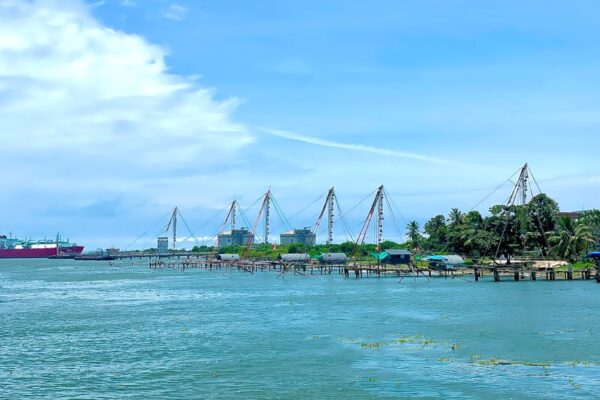
The iconic 14th-century nets at the harbour end, a short walk from Aspinwall.
16th-century spice warehouse and Biennale venue — the oldest commercial structure in this cluster.
Things to Do
The Kochi-Muziris Biennale fills Aspinwall with site-specific installations by international artists. Plan at least 2 hours for a thorough visit.
Even without an exhibition, the Victorian-era warehouse — exposed brickwork, iron beams, loading-dock doors — is architecturally remarkable. Self-guided exploration is rewarding.
The large archways opening toward the harbour frame excellent compositions of the Kochi waterfront, fishing boats, and the distant Ernakulam skyline.
Local Food Guide
Stays in Aspinwall House, Fort Kochi
Getting There
Budget Guide
| Category | Budget | Mid-range | Luxury |
|---|---|---|---|
| Accommodation / night | ₹1,200–2,500 (guesthouse) | ₹3,500–7,000 (boutique hotel) | ₹9,000–25,000 (heritage hotel) |
| Meals / day | ₹200–450 | ₹500–1,000 | ₹1,000–2,500 |
| Activities / day | ₹0–200 (most sites free) | ₹300–700 | ₹1,000–3,000 |
| 3 Nights Total | ₹2,800–7,250 (day trip from Ernakulam) | ₹12,600–22,700 (1-night stay) | ₹32,000–60,000+ (2-night heritage stay) |
Travel Tips
Check the Kochi-Muziris Biennale website for exact dates; the event runs for approximately three months every two years.
The Biennale uses venues across Fort Kochi and Mattancherry — the Biennale pass covers all; budget a full day rather than just Aspinwall.
Outside Biennale periods, the building may have limited access; check ahead for current exhibitions.
Aspinwall House is best combined with Pepper House (100 m) and the Chinese Fishing Nets (250 m) on the same walk.